.png)
ABS and Two Helmets Now Mandatory for All New Two-Wheelers in India from 2026
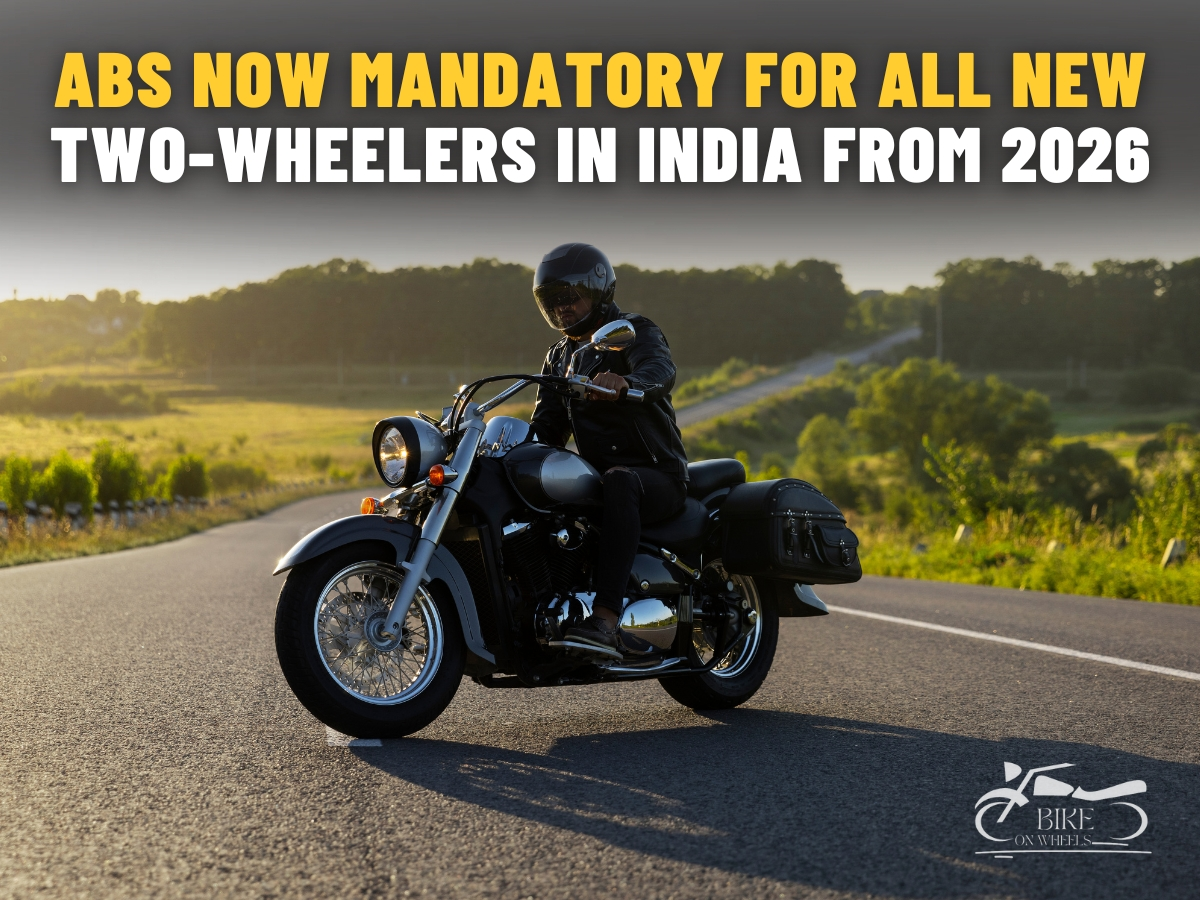
In an important development towards increasing road safety in India, the Ministry of Road Transport and Highways (MoRTH) has decided that from 2026 onwards, all new two-wheelers, irrespective of engine capacity, must be fitted with an Anti-lock Braking System (ABS). The manufacturers and dealerships will need to include two BIS-compliant helmets with every new two-wheeler sold, one for the rider and the other for the pillion.
This move is a part of a greater initiative to decrease the huge number of deaths caused by two-wheelers in India. Today, two-wheelers are responsible for almost 44% of road deaths in India. Most of these deaths are traced back to defective braking systems and helmet-less riding, primarily among backseat riders. The new regulation is set to correct both these faults directly.
Although the precise date of implementation remains uncertain, various reports confirm that the mandate will take effect on January 1 or April 1, 2026, depending on the report. Manufacturers have until October 1, 2026, to modify existing models. This phased process gives room for both production fine-tuning and market adjustment.
Currently, only motorcycles with engine sizes above 125cc are required to be fitted with ABS, while smaller capacity models are permitted to employ Combi-Braking Systems (CBS). But according to the new regulation, even entry-level scooters and motorbikes under 125cc will be required to employ ABS. This will achieve braking safety as a standard across the two-wheeler segments, an improvement concerning the widespread popularity in India of budget-friendly commuter motorbikes.
The government has also made a change in its helmet distribution policy. Up untill now, just a single BIS-approved helmet was made mandatory with every new two-wheeler. As per the new rule, two helmets, one for the rider and the other for the backseat rider, are now mandatory. This way, helmet safety is now safeguarded by default.
These safety requirements are likely to increase the cost of two-wheelers marginally. Having ABS, particularly on lesser bikes that did not originally need it before, may add another ₹5,000 to ₹7,000, based on the system type (single-channel or dual-channel) and the model of the vehicle. The inclusion of two helmets with certification as against one could also push the cost marginally higher. As much as this may be a damper for value buyers in the near term, the long-term gains in safety tip the balance far in favor of costs.
From the point of view of manufacturers, this policy shift will induce a whole series of product revisions across categories. Brands will have to redesign or retrofit their models in order to align with the new safety norms. The sub-125cc category, which constitutes a sizable portion of the Indian two-wheeler market, will be most impacted since a majority of these models don't currently have ABS. Companies may respond by innovating with new low-weight and affordable ABS solutions or strategically modifying engine sizes to cut down compliance expenses.
Dealerships will also have to get in line with the dual helmet regulation, making provision for stock and conformity with BIS certifications. Enforcement systems are most likely to be linked with the vehicle registration procedure to provide a guarantee that no vehicle will leave the production plant without the mandated safety hardware.
These fresh regulations are a reflection of the government's growing priority of minimizing road accidents and deaths with preventive approaches. Addressing both active safety (via ABS) and passive safety (via helmets), the new rules seek to make the environment for two-wheeler riders and passengers safer.
Since two-wheelers continue to be India's number one mode of personal transportation, these new safety norms are also likely to become the primary driver for changing both customer awareness and business practices. Sellers and buyers alike will need to prepare for the 2026 deadline.